
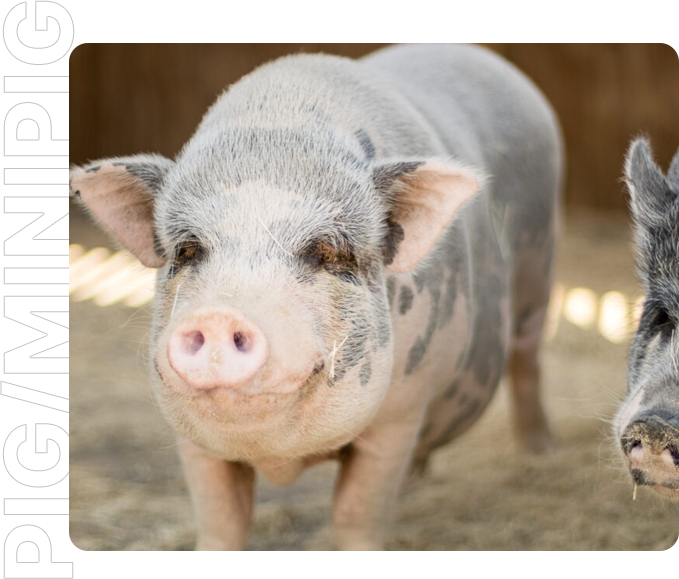
Pig & Minipig PBMCs

In biomedical research, pigs and minipigs serve identical roles as animal models, particularly due to their physiological and anatomical similarities to humans. However, significant differences between them influence their specific applications, ease of handling, and ethical considerations in laboratory settings.

Pigs and Minipigs in Biomedical Research

Standard pigs (such as domestic farm breeds) grow quite large, typically reaching weights of 300–500 kg. Minipigs, such as the Göttingen, Yucatan, and Sinclair breeds, have been selectively bred to remain smaller, generally weighing between 30–70 kg as adults. Their smaller size makes them more practical and cost-effective to house in research facilities, and they are easier for researchers to handle during studies.

Pigs are often used when larger organ or tissue samples are needed, or in studies where their rapid growth may be an asset. Minipigs maintain a high level of genetic uniformity, an advantage in clinical research because it reduces variability in study results. Minipigs also have a slower growth rate which is beneficial for long-term studies where consistency in physiology over time is important.

Standard pigs are frequently used in agricultural and veterinary studies, as well as in large-scale preclinical studies where a human-equivalent organ size is required, such as in cardiovascular, orthopedic, and gastrointestinal research. Minipigs are primarily used in human biomedical research, including toxicology, pharmacology, and dermatology. Their skin structure is closer to human skin, making them ideal for dermatological studies, wound healing, and drug delivery research.

Pigs/Minipigs PBMCs

Pig or minipig peripheral blood mononuclear cells (PBMCs) have been used in clinical research because they offer several advantages, mainly due to their similarities to human immune cells. Other benefits have been identified as listed below.

Similarity to Human Immune System
Model for Translational Studies
Compatibility with Human Genome
Ethical and Easy to Source
Reduced Need for Whole-Animal Testing
In Vitro Modeling for Personalized Medicine
Standardized Techniques and Protocols
Clinical Sample Considerations

Pig/minipig PBMCs share similarities with human immune cells in terms of cellular composition, which makes them consequential for studying immune responses to predict human immune system functions.

Pig/minipig PBMCs serve as a robust model for evaluating immune system reactions in drug testing, immunotherapy, and vaccine development, helping to predict responses in humans more accurately than rodent models.

Model for Translational Studies Pig/minipig PBMCs serve as a robust model for evaluating immune system reactions in drug testing, immunotherapy, and vaccine development, helping to predict responses in humans more accurately than rodent models.
Pigs and minipigs can be bred and maintained in controlled environments, and their PBMCs are easier to source than human PBMCs, providing a more ethical and readily available resource for large-scale studies.

In vitro studies with pig/minipig PBMCs can reduce the need for full-scale animal testing, as PBMCs provide a more ethical, cost-effective way to assess immune functions and drug effects.

By culturing pig/minipig PBMCs in vitro, researchers can model cellular responses to drugs, immune challenges, and genetic modifications, facilitating advancements in personalized medicine and immunotherapy.

Isolation, storage, and culture protocols for pig/minipig PBMCs are well-established, ensuring high-quality, reproducible results across studies and consistency in immune response modeling.
PBMC Preparation

PIG & MINIPIG PBMC Preparation

Animal Blood Collection

As required by institutional and ethical guidelines, the animal is anesthetized before blood collection. Blood collection can be accomplished depending on the size of the animal. For small animals such as rats and mice, blood is typically collected from the tail vein, retro-orbital sinus, or by cardiac puncture. For larger animals such as non-human primates, blood is commonly collected from a vein, mainly the saphenous or femoral vein. To prevent clotting, an anticoagulant is added immediately to the blood. Heparin or EDTA is usually used as anticoagulant. The blood is then gently mixed by inverting the tube several times. Vigorous shaking is avoided to prevent hemolysis.

Dilution of Blood

After addition of the coagulant, the blood is diluted with an equal volume of PBS or sterile saline. This step enables the reduction of cell density to facilitate better separation in the gradient. The solution is then gently mixed by inverting the tube.

Density Gradient Centrifugation

A density gradient medium is prepared by adding Ficoll-Paque or Histopaque to a sterile 15 mL or 50 mL centrifuge tube. Approximately 3 mL of density gradient medium per 10 mL of diluted blood is then used. The diluted blood is then layered carefully on top of the density gradient medium. By adding blood along the side of the tube using a pipette, mixing of the mixture is avoided. Next, the mixture is centrifuged at 400 x g for 20-30 minutes at room temperature. Gentle layer separation is ensured by not using the centrifuge brake.

Collection of PBMC Layer

The PBMC layer is identified based on its position alongside three other components. The top layer is composed of plasma. The second layer is thin and white, representing the PBMC layer. The third layer is made up of the density gradient medium which is either Ficoll or Histopaque. Finally, the fourth and bottom layer is composed of red blood cells. The second layer, which is the PBMC layer, is carefully harvested using a pipette and then transferred into a new, clean 15 mL centrifuged tube.

Washing the PBMCs

Once the PBMCs have been collected, PBS or culture medium is added to dilute the Ficoll or Histopaque. Next, the solution is centrifuged at 300 x g for 10 minutes at room temperature to pellet the PBMCs. After discarding the supernatant, the cell pellet is gently resuspended in fresh PBS or culture medium. This is followed by two more steps of washing to make sure no Ficoll/Histopaque and other contaminants remain.

Counting and Viability Assessment

To measure viability, cells are first counted using a hemocytometer or an automated cell counter. The cell concentration can be adjusted depending on downstream experiment requirements. Then, cell viability assessment is performed using tryphan blue staining or another similar method. Ideally, the viability of PBMCs for functional assays should be above 90%.

Storage/Immediate Use

If the freshly collected PBMCs are to be used immediately, cells are resuspended in an appropriate medium or buffer for further processing for techniques such as flow cytometry, cell culture, etc. If the PBMCs are to be stored for later use, the cells are frozen in a cryoprotective medium such as 10% DMSO in fetal bovine serum and then gradually cooled to -80°C before transferring to liquid nitrogen for long-term storage.


Sources: Fuss et al. (2009), Reidhammer et al. (2016).

We cryopreserve the cells in serum-free cryopreservation media to prevent potential effects of growth factors before and during international shipping. Let us know if you have special requests and we will be glad to accommodate them.

Pig & Minipig PBMC-Based Assays

PBMCs are a versatile sample type in preclinical research due to their role in the immune system. Assays using PBMCs help assess immune function, response to therapies, and disease pathophysiology.

Animal PBMCs are also commonly used in preclinical Safety, Toxicology and Translational research to help select the right in vivo model for late preclinial studies.

The following are common PBMC-based assays in preclinical research.

Common Assays

This assay quantifies and analyzes various immune cell subsets within PBMCs, such as T cells, B cells, NK cells, and monocytes. Flow cytometry is widely used to determine immune status in diseases like HIV or cancer, evaluate immune responses to therapies, and track cell phenotypes in clinical trials.

ICS is used to detect cytokine production within individual cells using flow cytometry. This assay helps identify specific functional responses, such as Th1, Th2, or Th17 responses, by measuring cytokines like IL-2, IFN-γ, and TNF. It’s particularly valuable in vaccine and immunotherapy studies.

These assays assess the cytolytic activity of PBMCs, particularly NK cells and cytotoxic T cells, against target cells. They are instrumental in cancer and viral research for evaluating how well immune cells can kill infected or tumor cells.

This technique analyzes gene expression at the single-cell level to characterize the transcriptome of individual cells. Its applications in immunology and oncology include exploration of the heterogeneity of immune cell populations, particularly in response to treatments or in different disease states.

TCR is a technique for identifying the diversity and clonality of T-cell receptors in PBMCs. It is valuable in cancer immunotherapy research for tracking immune responses and to understand T-cell repertoire dynamics in response to treatments, such as checkpoint inhibitors. These PBMC assays offer a comprehensive set of tools for understanding immune function and disease mechanisms of humans and animals in clinical research and are invaluable for monitoring immune responses to therapies across various fields.

Have you decided which PBMCs to use and what assays they are for?

ELISPOT measures the frequency of cytokine-secreting cells, indicating immune activation. It is often used in vaccine trials or infectious disease research to assess cellular immune responses by quantifying cytokines like IFN-γ, which indicates T-cell activation.

These assays measure the ability of PBMCs to proliferate in response to specific antigens or mitogens. They are used in immunological research to assess immune responsiveness in autoimmune diseases, vaccine trials, or immunodeficiencies. Proliferation assays help determine immune system activation and potential deficiencies in cell-mediated immunity.

The purpose of this assay measures gene expression changes in PBMCs using techniques like qPCR or RNA sequencing. Applications in autoimmune and infectious disease research include revealing insights into immune response mechanisms as well as helping identify biomarkers for disease progression and treatment response.

MLR is used to measure the response of immune cells to foreign cells. Its typical application is in transplant immunology which is to assess compatibility, by helping understand immune responses to allogeneic tissues and immune tolerance.

Published Study That Used Minipig PBMCs

The study by Pernold et al. (2024) titled “Species comparison: human and minipig PBMC reactivity under the influence of immunomodulating compounds in vitro,” explores the use of minipigs as a translational model for studying immune responses and drug effects, given their physiological and immunological similarities to humans. The research focuses on peripheral blood mononuclear cells (PBMCs) from humans and Göttingen minipigs, examining their reactivity to immunomodulatory compounds through T-cell proliferation assays.

Key Highlights of Pigs & Minipig PBMCs

Antigen-Specific Restimulation

In minipigs immunized against porcine circovirus 2, all drugs reduced proliferative responses, with rapamycin being most effective. This research underlines the relevance of minipigs as a model for studying immune-modulating drugs and emphasizes the importance of tailoring stimuli and conditions for accurate interspecies comparisons in drug development.

Drug Effects

Immunosuppressive drugs (abatacept, belatacept, rapamycin, and tofacitinib) showed species-specific responses. For instance, abatacept significantly reduced T-cell proliferation in minipigs compared to belatacept, highlighting differences in drug efficacy due to species-specific molecular interactions

Stimuli Dependency

The suppressive effects of drugs varied with the type of stimulation (e.g., concanavalin A, phytohemagglutinin-L, and staphylococcal Enterotoxin B).

T-cell Responses

CD4+ T cells showed higher activation in humans, while CD8+ T cells were more abundant in minipigs.

We Ensure Quality

To see to it that the minimum cell number post-thaw is achieved for each unit shipped, we overfill containers with cells by 50%.

We cryopreserve the cells in serum-free cryopreservation media to prevent potential effects of growth factors before and during international shipping via our logistics partners.

We typically ship cells that are in stock within two days. New projects can be delivered within 2 weeks for minipig / pig / beagle / monkey / llama and 3 weeks for alpaca PBMCs.

We ship cells Europe-wide within 24-48 hours, and can ship intercontinentally with dry shipper.